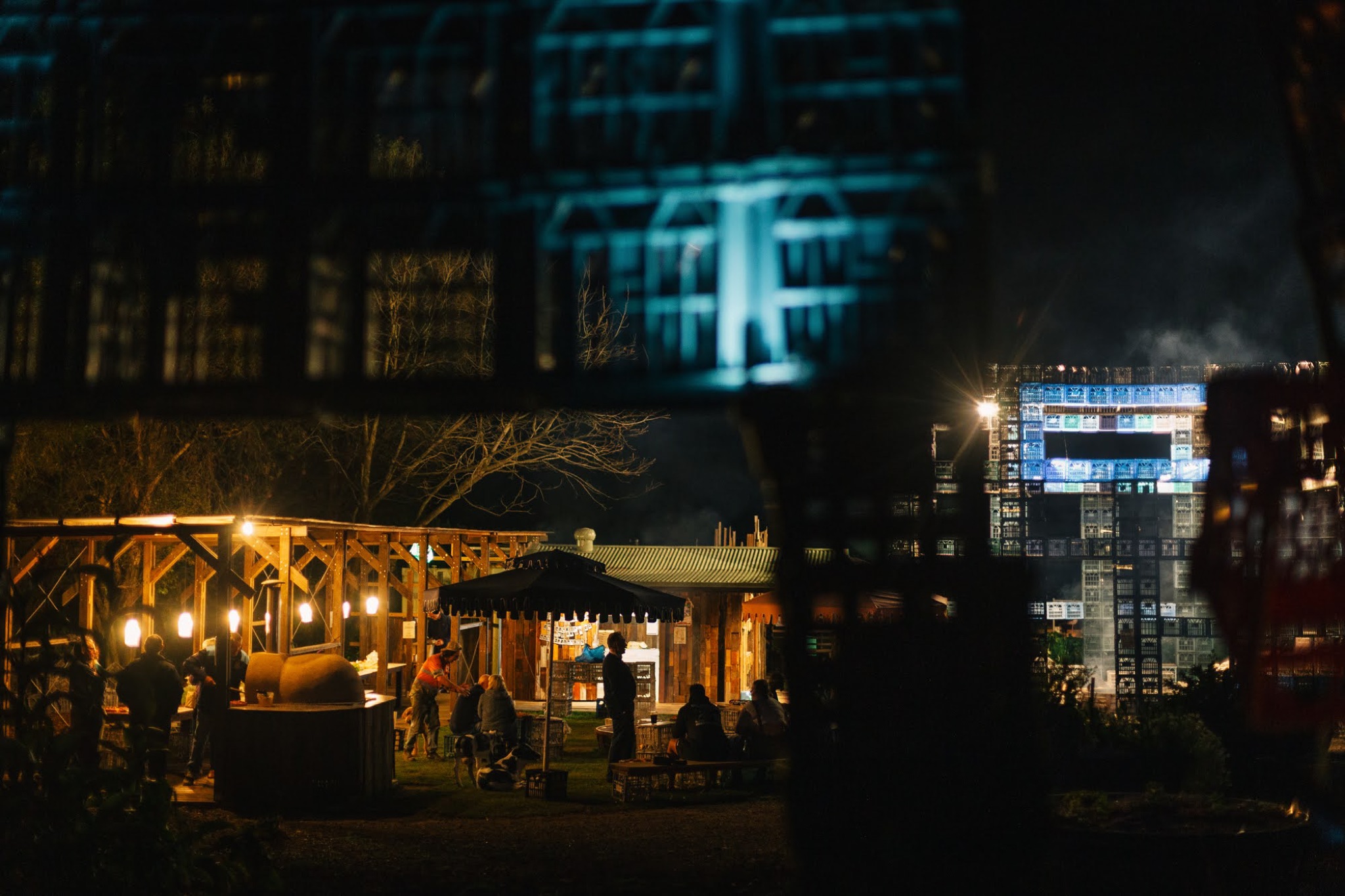
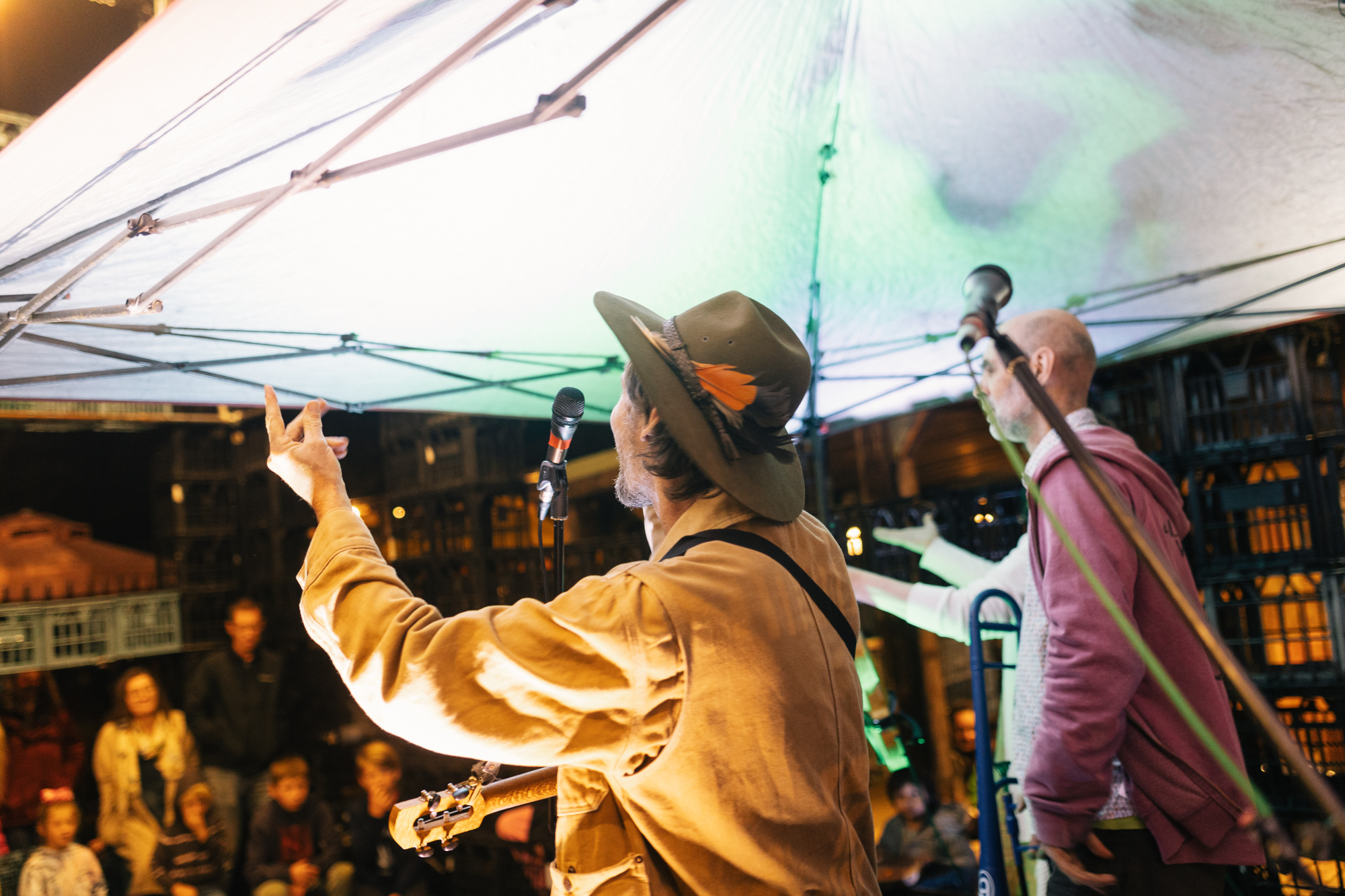
In September, Formidable Vegetable played at The Harvest in Witta, on Jinibara Country. I keep looking at the photographs from that night. A musician under the canopy. People gathered in the dark, with the lights above them.
There is a photograph from March that I want to put beside them. Milk crates spread across the grass. People standing around them. At that point, there was still so much to work out.
We began Radical Scoops asking how art might carry something of the dairy, timber and co-operative histories of this part of the Blackall Range. Nic and I could talk about that for hours. The crates gave us something to pick up.
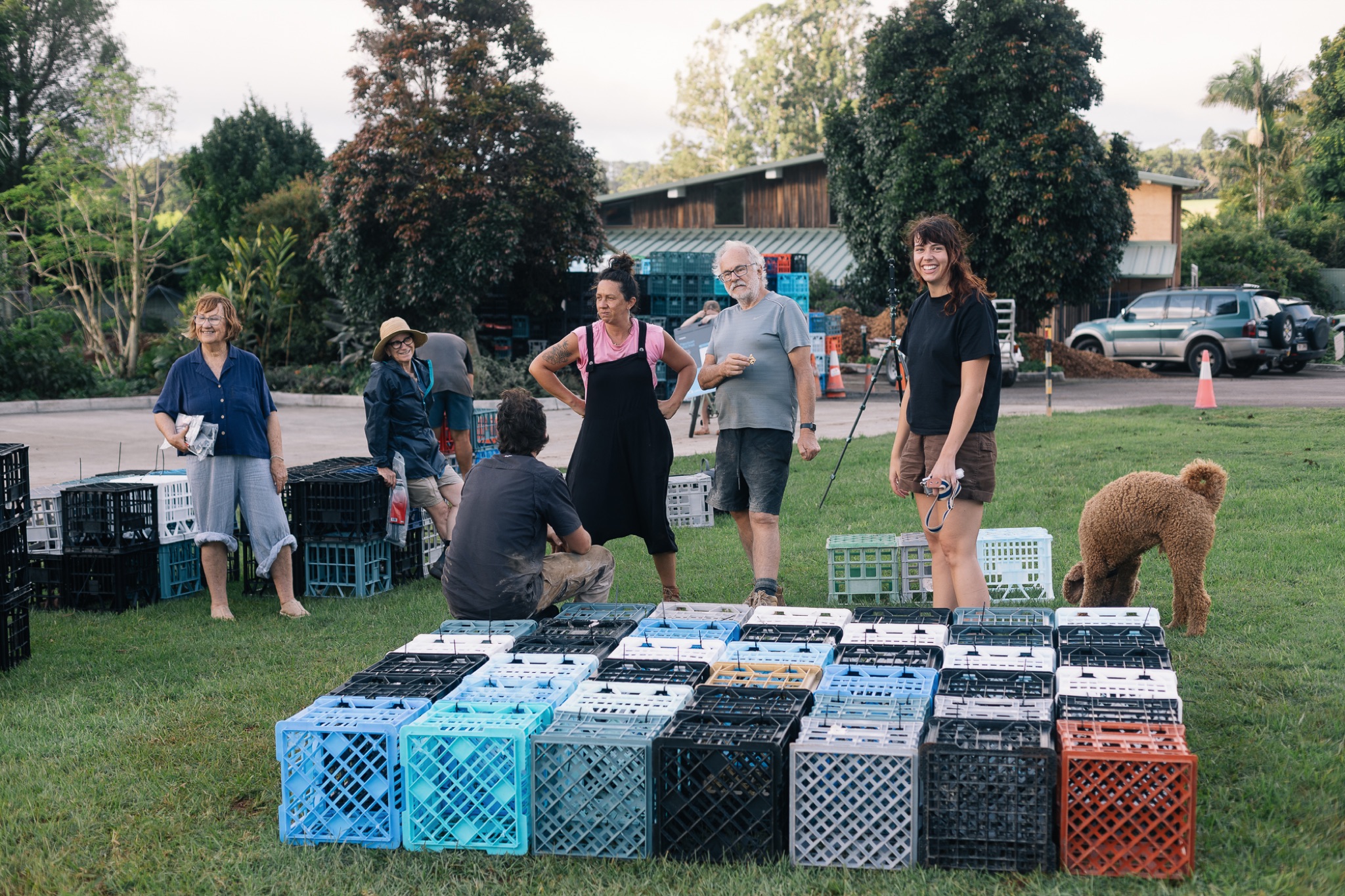
I like that they already had a use. A crate is made to hold something, to be carried and stacked and passed on. Its shape is familiar. You can look at one and begin to work out what you might do with it.
At The Harvest, that became a place to gather while the rest of the site was still being worked on. The unfinished parts were there for everyone to see. People could walk through and imagine where they might fit.
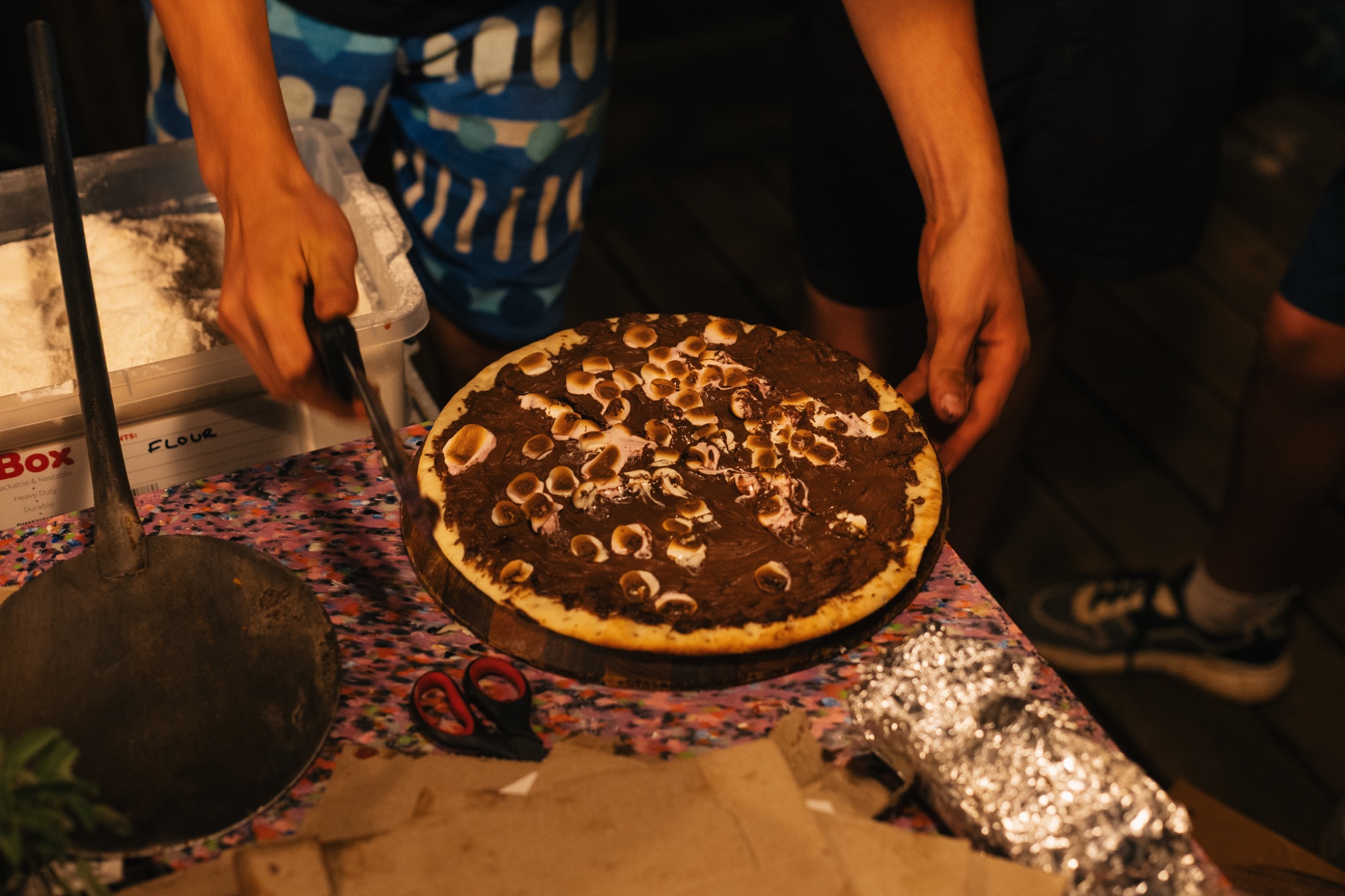
On 20 June, we opened the gate. Makers came through in the morning. There were conversations about shelves, workshops, signs and meals. Later, people made pizzas and passed boards across the table.
In the journal entry I wrote after the opening, I called what was happening a public rhythm. I am still trying to understand what it takes to keep that going. Opening a gate is one thing. Having somewhere people want to return to asks more of us.
There is the work of making a place and then there is the work of keeping it available. Repairs, organising, cleaning up. The garden needs attention. Someone has to get the next meal ready. I want that ordinary work to have a place in how we talk about the art.
Then I come back to September and the music under the canopy. Something we had been trying to explain was there in front of us, being used.
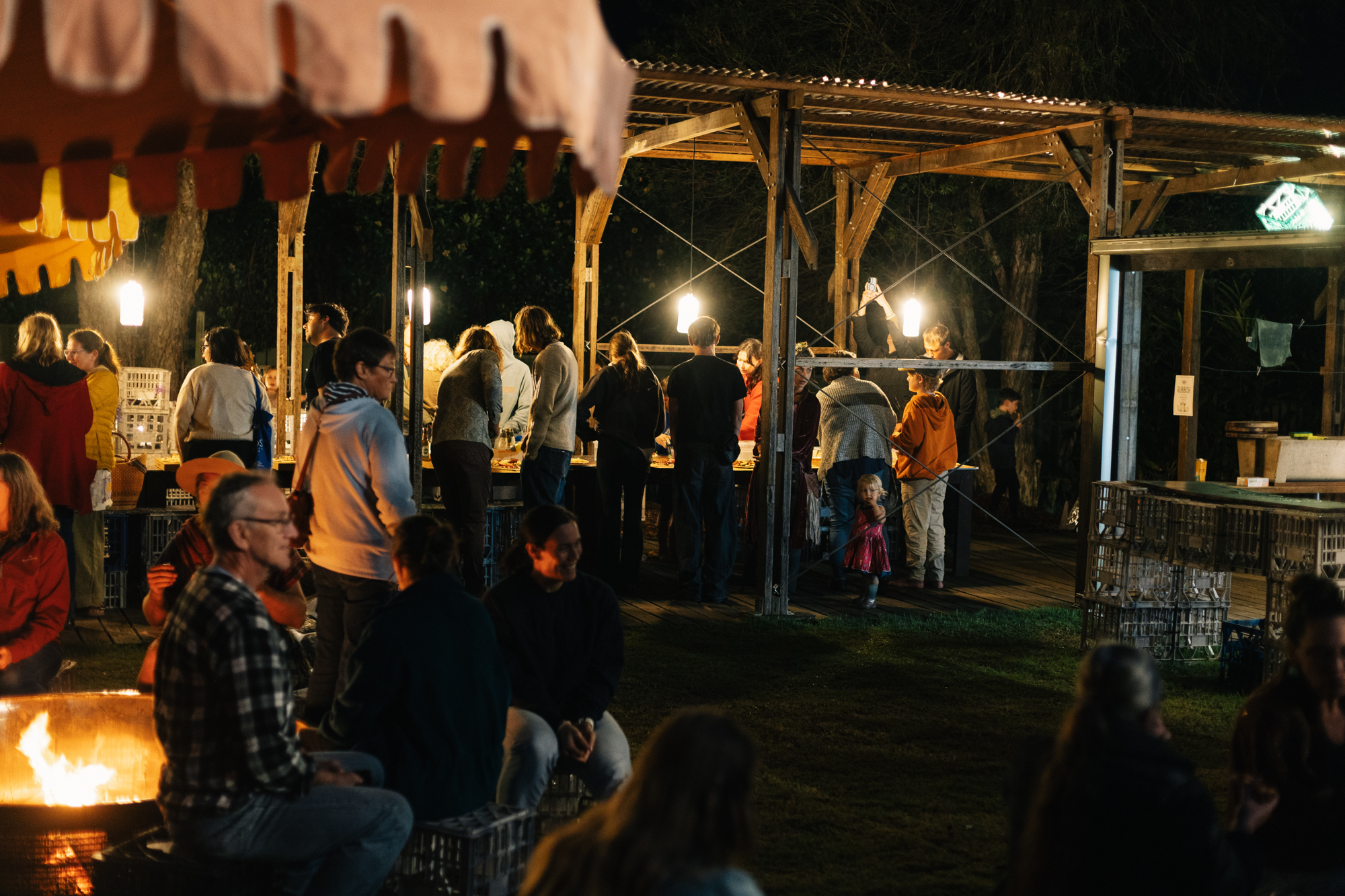
In A Way to Be Here, I wrote about wanting to give an idea a form people can spend time with. Looking through these photographs helps me understand what I meant. The form gives us somewhere to begin. Other people bring things to it that we could never have put there ourselves.
As the residency comes towards its end, I want to leave room for that. I can put the photographs in order and write about what I see. The next time someone walks through the gate, the place will mean something to them that I have yet to hear.
I hope we keep making room for that conversation.
What came out of the residency
When we started stacking crates, Barry helped fill in what we didn’t know. People talked about the dairy co-ops and the mills. At the gathering in the rain, those same histories kept coming back. We heard them while we were putting tables together and passing oysters around.
By June the makers were walking through the place and talking about what they might bring: a shelf, a workshop, a sign. The pavilion gave us somewhere to gather. Pizza gave people a way to join in. In September it was somewhere to hear music. I can see the work differently in each of those photographs.
It felt exposed to open the gate with so much still to do. Looking back, I’m glad people could see the unfinished parts. Someone could picture a workshop in a room we’d only thought of as a room that needed work.
Coming soon: The Milk Bar
We’re working on a Milk Bar at The Harvest. I want a counter where we can hear what people remember ordering and see what someone here might make with that memory. I’d like to put a piece of chalk beside a board that asks, I’ve always wanted to make ______. Someone might write down a milkshake. Someone else might want to build an oven or learn to graft a tree.
I’d like to follow some of those answers with a camera and a notebook, with the people who want to tell us more. A gardener at work on a Wednesday. An artist halfway through making something. Someone who knows when the pizza oven is ready by looking at the fire. That’s the Harvest journal I want to make next.
Radical Scoops is the 2026 industry residency undertaken by Nicholas Marchesi and Benjamin Knight of A Curious Tractor, with Regional Arts Australia and ANAT. With thanks to the people who have helped make and care for The Harvest and to Formidable Vegetable.